Finding the Right Weapon Can Change Every Match
Winning in Free Fire isn’t only about quick reflexes or fast movement. The Free Fire weapon you carry throughout a match has a huge impact on your overall performance. From landing your first shots to surviving the final safe zone, every gun behaves differently depending on its range, damage, accuracy, recoil, and firing speed.
With dozens of weapons available across different categories, choosing the right one isn’t always easy. Some players prefer aggressive close-range fights, while others perform better using accurate long-range rifles or balanced all-round weapons. Understanding how every weapon works makes it much easier to adapt during different situations instead of depending on luck.
Whether you’re playing Battle Royale, Clash Squad, Lone Wolf, or special game modes, selecting the correct weapon combination can improve both survival and combat efficiency.
Why Weapons Are So Important
Every match begins differently.
Sometimes you’ll find powerful loot immediately after landing, while other times you’ll need to fight using whatever equipment is available nearby.
Because of this, experienced players don’t rely on just one favorite gun. Instead, they learn how different weapons perform across multiple situations. A well-balanced loadout allows players to handle close-range encounters, medium-distance fights, and long-range engagements without being limited to a single combat style. Learning the strengths and weaknesses of every weapon also helps players react faster whenever the available loot changes during a match.
Understanding Weapon Performance
Every weapon is designed with unique characteristics that influence gameplay. Some guns fire extremely fast but deal lower damage, while others deliver powerful shots with slower firing speeds.
Several important factors determine how a weapon performs:
- Damage
- Accuracy
- Fire Rate
- Range
- Reload Speed
- Magazine Capacity
- Recoil Control
- Movement Speed While Shooting
Rather than focusing on only one statistic, experienced players usually consider all of these factors before deciding which weapon best suits their playstyle.
Different Playstyles Need Different Weapons
No single weapon is perfect for every player. Someone who enjoys rushing enemies may prefer fast-firing SMGs or powerful shotguns, while players who enjoy strategic positioning often choose assault rifles, marksman rifles, or sniper rifles.
The ideal weapon depends on several factors, including:
- Preferred combat distance
- Individual aiming style
- Game mode
- Team composition
- Available attachments
- Current map
Because every match is unique, learning multiple weapon types provides greater flexibility throughout the game.
What You’ll Learn in This Guide
This guide covers everything needed to understand the Free Fire weapon system.
Inside this article, you’ll learn about:
- Weapon Categories
- Best Guns for Different Playstyles
- Strengths and Weaknesses
- Combat Roles
- Evo Weapons
- Weapon Balance Updates
- Choosing the Right Loadout
- Tips for Different Game Modes
Instead of focusing on only one powerful gun, this guide explains how different weapons perform in real gameplay situations and why selecting the right combination often makes a bigger difference than simply choosing the highest damage weapon.
Understanding Free Fire Weapon Categories
Every weapon in Free Fire is designed for a specific combat role. Some weapons perform best during close-range battles, while others provide greater accuracy over longer distances. Understanding these categories helps players build balanced loadouts and adapt to different situations instead of relying on a single gun throughout every match.
Rather than choosing weapons only because they’re popular, experienced players focus on how each category fits their playstyle and the current game mode.
Assault Rifles
Assault Rifles are among the most versatile weapons in Free Fire. They offer a balanced combination of damage, accuracy, range, and fire rate, making them suitable for almost every situation.
These weapons perform well during medium-range combat while remaining effective in many close-range encounters. Their balanced performance makes them a popular choice for both beginners and experienced players.
Most players keep at least one assault rifle in their loadout because of its reliability across different maps and game modes.
Submachine Guns (SMGs)
SMGs are designed for fast-paced, close-range combat.
Their high fire rate allows players to deal continuous damage during aggressive fights, making them especially effective inside buildings, tight spaces, and Clash Squad matches.
Although they usually have shorter effective range than assault rifles, their mobility and rapid firing speed make them excellent choices for players who prefer rushing opponents.
Shotguns
Shotguns specialize in extremely close-range engagements.
A well-placed shot can deal massive damage, rewarding players with accurate aim and proper positioning. However, their effectiveness drops quickly as distance increases.
Players who enjoy aggressive gameplay often use shotguns during fast pushes, building fights, and final-circle encounters where close combat becomes unavoidable.
Sniper Rifles
Sniper rifles are built for precision.
They provide excellent long-range damage and reward players who maintain strong positioning and accurate aim. Instead of rushing into combat, sniper users often control open areas by engaging opponents from a safe distance.
While these weapons require patience and accuracy, they can completely change the outcome of a match when used effectively.
Marksman Rifles
Marksman rifles bridge the gap between assault rifles and sniper rifles.
They offer serious damage at medium to long distances while allowing faster follow-up shots than traditional sniper rifles.
This balance makes them suitable for players who prefer accurate shooting without sacrificing too much mobility during combat.
Light Machine Guns (LMGs)
LMGs focus on sustained fire.
Their large magazine capacity allows players to suppress enemies for longer periods without reloading frequently. This makes them useful during squad fights, defensive positions, and situations where continuous fire provides a tactical advantage.
Although they may feel heavier than other weapon categories, their ability to maintain pressure often proves valuable during extended engagements.
Pistols
Pistols usually serve as backup weapons during the early stages of a match.
While they are generally less powerful than primary weapons, certain pistols remain surprisingly effective when used with accurate aim.
Many players rely on pistols until they find stronger equipment, making them an important part of early-game survival.
Melee Weapons
Melee weapons require players to fight at extremely close range.
Although they are rarely used as primary weapons, they become useful whenever ammunition runs out or during unexpected close encounters.
Some melee weapons also provide small movement or utility advantages depending on the current game mechanics.
Throwables
Throwables add an extra tactical layer to combat.
Grenades, utility items, and other throwable equipment allow players to clear buildings, force enemies out of cover, block movement, or create opportunities for their teammates.
Using throwables effectively often depends more on timing and positioning than raw aiming skill.
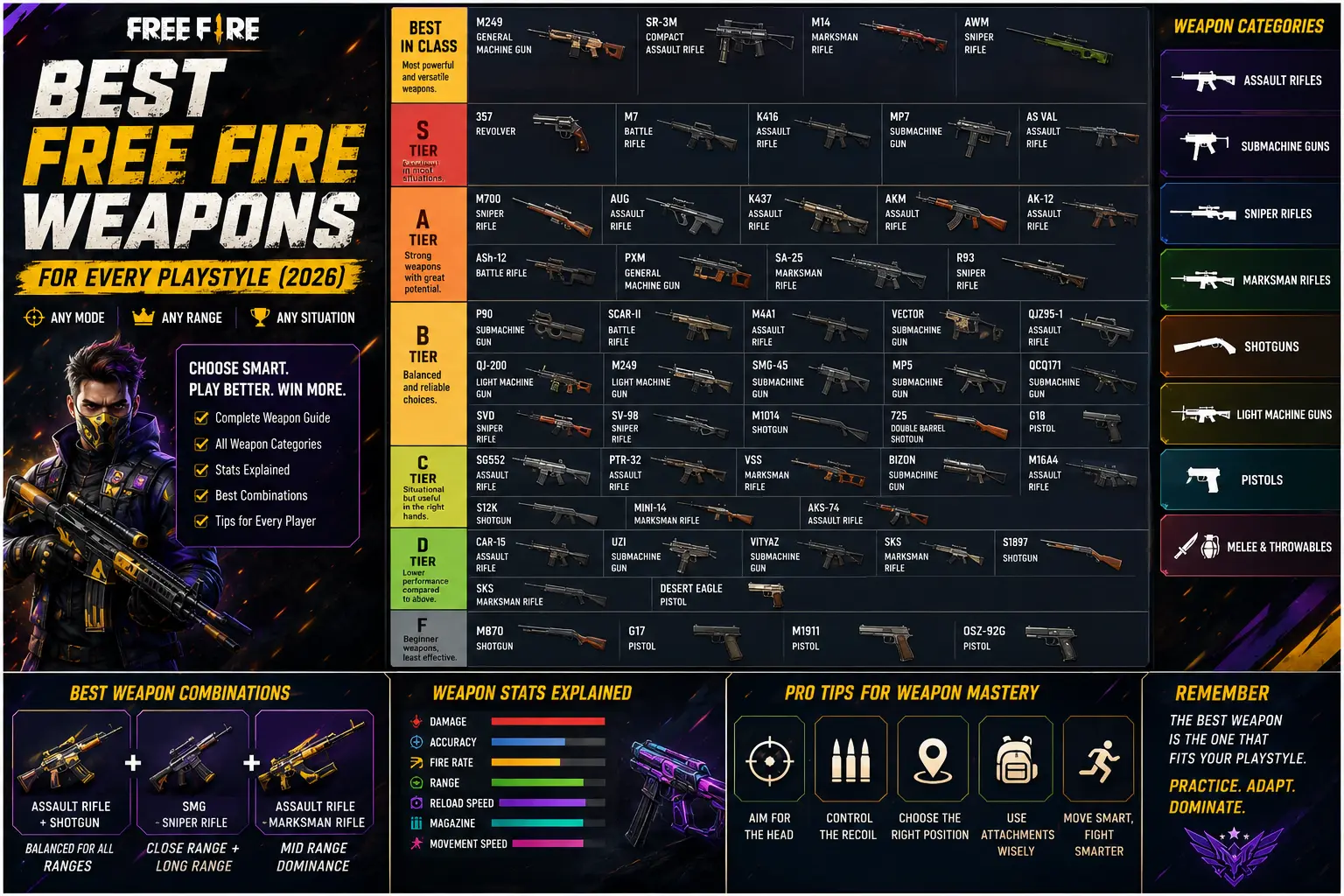
Choosing the Right Weapon Combination
Instead of carrying two similar weapons, many experienced players combine different categories to cover multiple combat ranges.
For example:
- Assault Rifle + Shotgun
- SMG + Sniper Rifle
- Assault Rifle + Marksman Rifle
- LMG + Shotgun
Balanced combinations help players remain prepared for changing situations throughout the match instead of struggling whenever combat distance changes.
Understanding Weapon Performance in Free Fire
Winning fights consistently isn’t just about finding rare weapons. Understanding how different weapon statistics affect gameplay allows players to make better decisions throughout every match.
A weapon with more serious damage isn’t always the strongest choice. Accuracy, recoil, firing speed, reload time, and effective range all work together to determine how a weapon performs in real combat situations.
Learning these mechanics helps players improve their overall gameplay rather than depending on a single powerful gun.
Damage Isn’t Everything
Many players immediately choose the weapon with the highest damage, but that’s only one part of overall performance.
A slower weapon may deal more damage per shot, while another weapon with a faster fire rate can deliver higher overall damage during continuous combat.
Instead of comparing only damage numbers, experienced players also consider:
- Fire Rate
- Accuracy
- Effective Range
- Magazine Capacity
- Reload Speed
- Recoil Control
Balancing these factors often leads to more consistent performance across different situations.
Accuracy and Recoil Control
Accuracy becomes increasingly important during medium and long-range battles.
Weapons with stable recoil patterns allow players to keep their crosshair on target while firing multiple shots.
Poor recoil control can cause bullets to spread away from the enemy, reducing overall effectiveness even when using powerful weapons.
Improving burst firing, tap shooting, and recoil management can often produce better results than simply switching to another weapon.
Fire Rate and Mobility
Fast-firing weapons are especially effective during close-range encounters where reaction time matters the most.
Higher fire rates allow players to apply constant pressure and finish fights quickly, especially inside buildings or during Clash Squad matches.
However, fast-firing weapons often consume ammunition more quickly and may become less effective at longer distances.
Choosing the right balance between mobility and sustained fire depends on both the game mode and personal playstyle.
Effective Range Matters
Every weapon performs best within a certain distance.
Close-range weapons excel during aggressive pushes, while long-range weapons reward patience and accurate positioning.
Instead of forcing every fight with the same weapon, successful players adapt their strategy based on combat distance and available cover.
Understanding effective range allows players to maximize each weapon’s strengths while avoiding situations where it performs poorly.
Weapon Attachments
Attachments can significantly improve weapon performance by increasing stability, magazine capacity, reload speed, or overall handling.
Finding the right attachments during a match allows players to adapt their equipment without completely changing their preferred loadout.
Depending on the available equipment, attachments may improve:
- Accuracy
- Stability
- Reload Speed
- Magazine Size
- Weapon Control
Although attachments vary throughout different matches, learning how they influence weapon handling helps players react more effectively when upgrading their gear.
Evo Weapons
Evo Weapons introduce an additional layer of progression by combining gameplay improvements with visual upgrades.
Unlike standard weapons, Evo Weapons often feature unique animations, enhanced visual effects, and unlockable cosmetic upgrades as players progress through different levels.
While their appearance changes significantly, successful gameplay still depends on aiming skill, positioning, and decision-making rather than cosmetic enhancements alone.
Weapon Balance Updates
Every major update may introduce adjustments that improve or reduce the effectiveness of certain weapon categories.
Balance changes help maintain fair gameplay by preventing a small number of weapons from dominating every match.
These updates may affect:
- Damage
- Accuracy
- Fire Rate
- Reload Speed
- Range
- Recoil
Following weapon balance updates allows players to adapt their strategies instead of relying on outdated loadouts.
Choosing Weapons for Different Game Modes
Different game modes reward different weapon choices.
Battle Royale usually encourages balanced loadouts capable of handling multiple combat ranges, while Clash Squad often favors fast-paced close-range weapons because of its smaller maps and quicker engagements.
Players who regularly switch between game modes benefit from learning multiple weapon categories instead of depending on one specific setup.
Developing flexibility makes adapting to future updates much easier.
Practice Builds Better Performance
Improving weapon skills takes consistent practice.
Instead of constantly changing weapons after every match, spending time learning recoil patterns, movement, crosshair placement, and positioning often produces better long-term results.
The more comfortable players become with different weapon categories, the easier it becomes to react confidently during intense combat situations.
Building the Perfect Weapon Loadout
There is no single weapon combination that guarantees victory in every Free Fire match. The best loadout depends on your preferred playstyle, game mode, map, and the situations you encounter throughout the game.
Many experienced players combine two different weapon categories instead of carrying similar guns. This approach allows them to stay prepared for both close-range encounters and long-distance fights.
For example, pairing a close-range weapon with a medium or long-range option creates a more balanced setup and reduces the need to avoid certain combat situations.
Instead of searching for one “perfect gun,” focus on building a loadout that complements your strengths while giving you flexibility during every stage of the match.
Common Mistakes Players Make
Many players lose fights because of simple weapon-related mistakes rather than poor aim.
Some of the most common mistakes include:
- Using close-range weapons during long-distance fights.
- Ignoring weapon recoil and accuracy.
- Carrying two weapons with similar combat roles.
- Reloading at unsafe moments.
- Changing weapons too frequently without learning their mechanics.
- Ignoring available attachments during the match.
Avoiding these mistakes can improve consistency and make every fight feel more controlled.
Improving Your Weapon Skills
Learning weapon mechanics takes time, but consistent practice produces noticeable improvements.
Players can develop better performance by focusing on:
- Crosshair placement before engaging enemies.
- Controlling recoil during continuous fire.
- Switching weapons quickly when necessary.
- Choosing better positions before starting fights.
- Practicing with multiple weapon categories instead of relying on only one favorite gun.
Building confidence with different weapons allows players to adapt more easily whenever updates introduce balance changes or new equipment.
Staying Updated With Future Weapon Changes
The Free Fire weapon system continues evolving through regular updates.
New weapons, balance adjustments, gameplay improvements, and mechanical changes may influence which weapon categories become stronger or require different strategies.
Keeping up with future updates helps players understand how these changes affect gameplay without having to relearn everything from the beginning.
As the game continues to grow, learning the fundamentals of every weapon category remains more valuable than depending on temporary trends.
Continue Exploring Free Fire Weapons
Every weapon category offers a different experience, and understanding their unique strengths makes it easier to improve overall gameplay.
If you’d like to learn more, explore our detailed guides covering:
- Assault Rifles
- Submachine Guns (SMGs)
- Shotguns
- Sniper Rifles
- Marksman Rifles
- Light Machine Guns (LMGs)
- Evo Weapons
- Weapon Balance Updates
Each guide explores its topic in greater detail to help you make informed decisions during every match.
Final Thoughts
Free Fire offers one of the most diverse weapon systems in mobile battle royale gaming. Rather than searching for a single overpowered gun, successful players focus on understanding weapon categories, adapting to different situations, and improving their decision-making throughout every match.
Whether you prefer aggressive close-range combat or patient long-range engagements, learning how each weapon performs gives you more control over the outcome of every battle.
As new updates introduce additional weapons and gameplay adjustments, staying familiar with the complete weapon system will continue helping players build stronger loadouts and improve their overall performance.
The more experience you gain with different weapon categories, the easier it becomes to adapt, compete, and enjoy everything Free Fire has to offer.
Continue Reading
If you’d like to learn more about Free Fire weapons and improve your gameplay, explore these detailed guides:
- Best Assault Rifles in Free Fire
- Best SMGs in Free Fire
- Best Shotguns in Free Fire
- Best Sniper Rifles in Free Fire
- Free Fire Weapon Tier List
- Best Free Fire Characters
- Latest Free Fire OB Updates
- Free Fire News
As more guides are published, this section will continue expanding with additional resources covering weapons, gameplay strategies, updates, and other important topics to help players stay informed.
